How to Build a 20-Minute Daily Reading Habit on Your UK Commute
Twenty minutes a day is ten hours a month. Put that alongside a novel of three hundred pages and you have a book finished before the season changes, paid for entirely with time you already spend on the train, the bus or the walk to the station. The difficulty is not finding the time. It is deciding, in advance, what happens during it. A commute reading habit works when it is small, specific and tied to something you already do. Here is how to build one.
Why Twenty Minutes Beats an Hour
An hour-long reading target sounds ambitious on a Sunday evening and collapses by Tuesday. Twenty minutes survives. It fits inside a delayed train, a short bus hop, or the gap between arriving at the station and your platform being announced.
Short sessions have one cost: you lose the thread between readings. Choose books that forgive interruption, with short chapters, clear scenes or self-contained sections. A dense family saga with forty characters can be wonderful, but it is hard work in ten-minute pieces. Save it for the sofa.
The point is not pace. Someone who reads for twenty minutes on most days will finish far more books than someone who plans a two-hour Sunday session and manages twenty minutes of it. Consistency beats volume, every time.
Choose the Book Before You Leave the House
The habit tends to die at the moment of choice. Bag on the floor, one eye on the clock, and the phone wins because it is already in your hand. Remove the decision instead of fighting it: keep one book in your bag and leave it there. When you finish it, replace it that evening.
Two small rules help. Pick something that suits being put down and picked up again, rather than a book you have to be in the right mood for. And carry a backup, whether that is a slim paperback or a short story collection, so a slow, difficult read never leaves you with nothing to open.
Match the Format to the Journey
Trains
A quiet train with a table and two free hands is the easiest reading environment you will get all week. Take full advantage. A paperback or e-reader both work, and a seat by the window reduces the distractions coming past your shoulder.
Busy buses and standing room
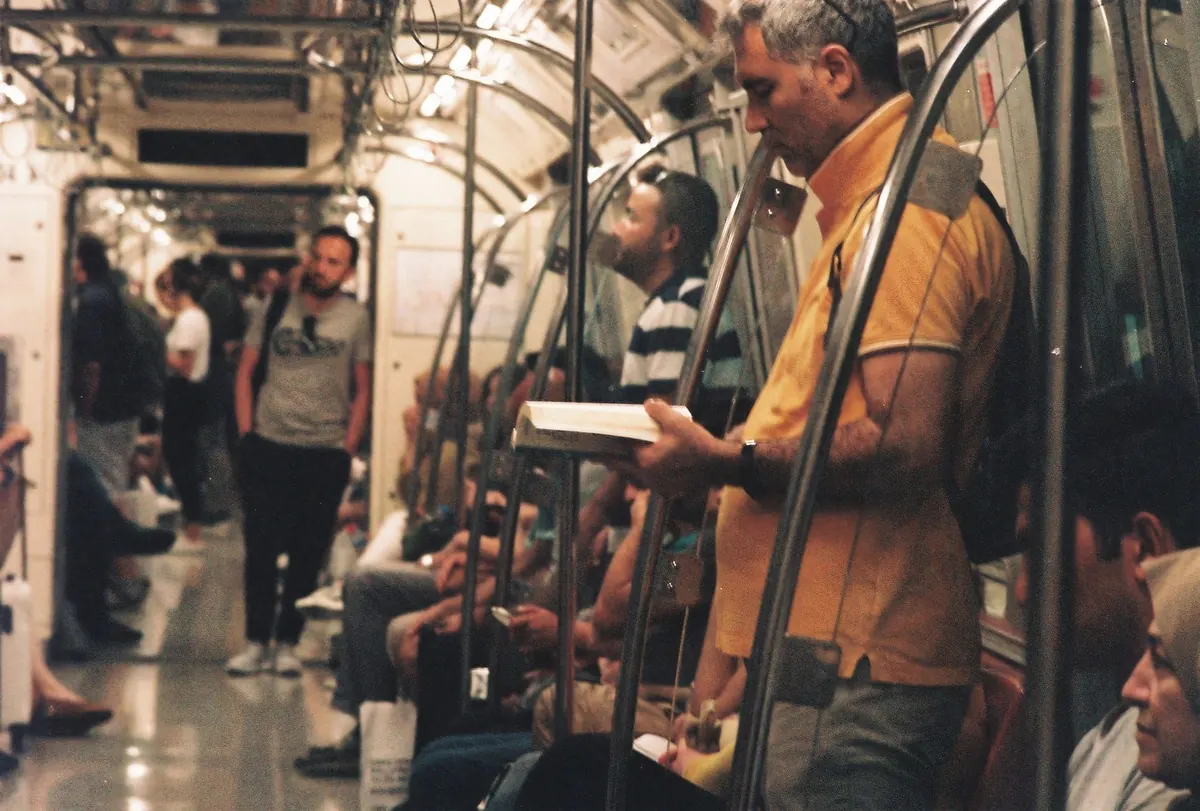
A packed commuter service is a different job. Standing up, a paperback in one hand and a rail in the other is entirely realistic, though an e-reader you can turn with a thumb is easier. Reading on a phone works too, provided you silence notifications first. Otherwise you will answer one message and lose fifteen of your twenty minutes.
Walking
Reading on foot is neither safe nor sensible. Treat the walk as listening time instead: an audiobook on the way in, pages on the way home if part of your journey involves a seat. If you would rather keep your reading visual, save the twenty minutes for later in the day and keep your eyes on the pavement.
Attach the Reading to a Fixed Cue
Habits stick when they hang off something that already happens without fail. Your cue might be sitting down on the train, passing through the ticket barrier, or the moment the bus pulls away from your stop. Pick one, and make the first action after it the same every time: book out, and book out before the phone comes out.
That order matters more than willpower. You are not fighting a lack of interest in reading; you are fighting a well-worn habit of reaching for a screen.
It also helps to decide which part of the journey belongs to you. Early is safer than late, because delays, phone calls and conversations tend to eat the end of a trip rather than the beginning. On a forty-minute journey, take the first twenty minutes and leave the rest for messages or staring out of the window.
Sort the Practical Details
None of this is complicated, but small frictions add up. A book that takes thirty seconds to find is a book you will not read.
- Keep the book in the same pocket or the same part of your bag, so your hand finds it without looking.
- Charge an e-reader on a fixed day each week rather than the night you need it.
- Leave a spare book in your desk drawer for the journey home, in case you forget the main one.
- Carry headphones if carriage noise pulls you out of the page.
- Sit in the same carriage or the same seat where you can; familiar surroundings cut down on the fidgeting that swallows the first five minutes.
- Keep a bookmark that stays put, so you are not hunting for your place while the train fills up.
Keep Going When the Commute Changes
Trains get cancelled. You get a lift. You work from home for a week. A good habit bends rather than breaks, so have a few fallbacks ready.
- Move the twenty minutes rather than cancelling them. Read at the kitchen table before you leave, or in the ten minutes before your first meeting.
- Use waiting time. A delayed platform announcement is still reading time.
- Split the session. Ten minutes on the way in, ten on the way back.
- Change format. If you are walking instead of sitting, listen instead of reading.
- Never miss twice. One missed day is nothing; two in a row is how a habit quietly disappears.
Start With Your Next Journey
Tonight, put a book in your bag. Tomorrow, take it out at the first cue of your journey, before you touch your phone, and read until your stop comes round. That is the whole system: a book within reach and a fixed moment to open it.
Give it a fortnight. By then the reaching and the reading will have joined up, and the journey will feel shorter rather than longer. If you miss a morning, put the book back in your bag and pick it up again on the way home.
Photo: Berşah B. / Pexels